
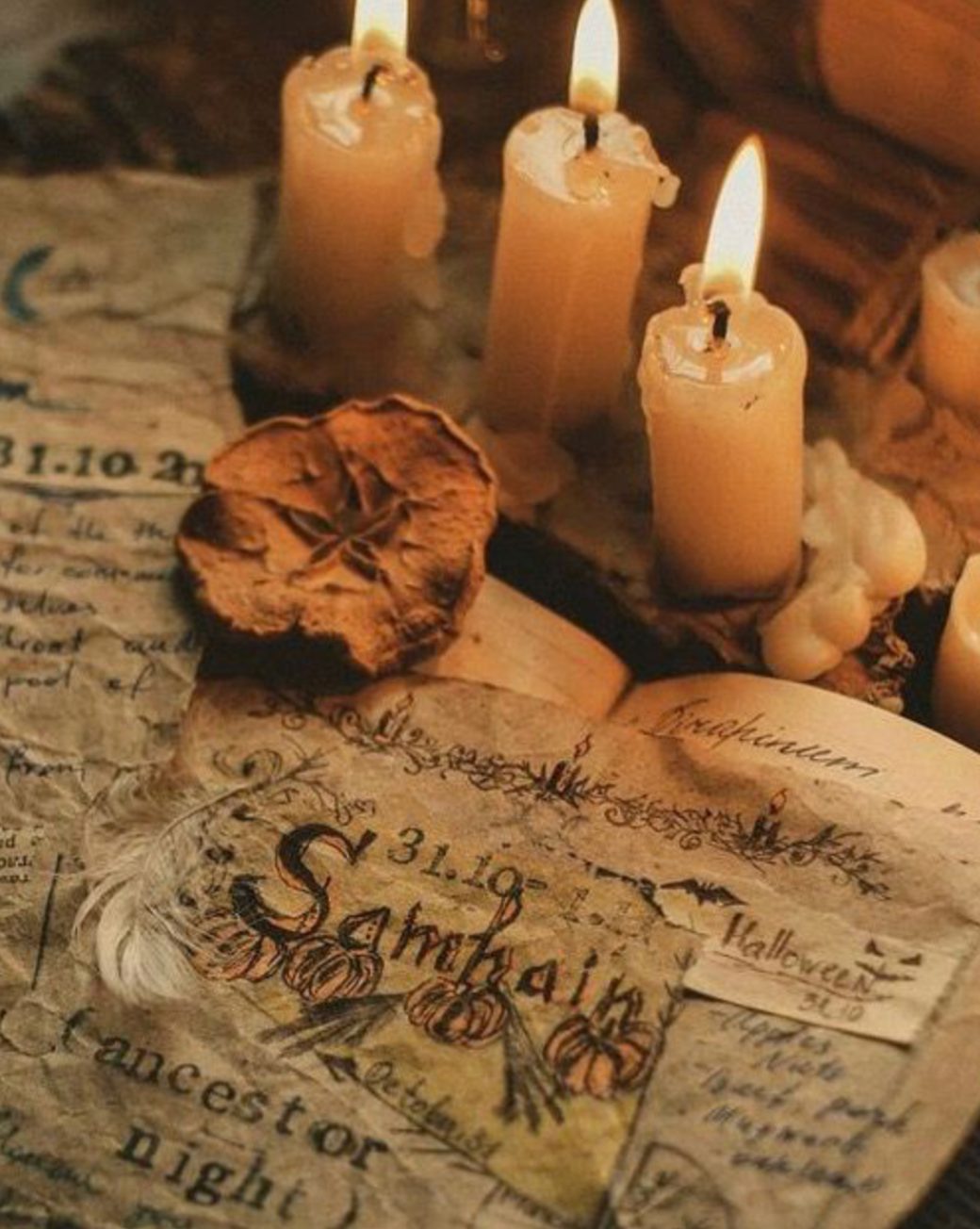
Samhain marks a threshold rather than a celebration. It is not a holiday of excess or performance, but a spiritual hinge in the year where one season gives way to another and the unseen presses closer to the seen. Traditionally observed as the end of the harvest and the beginning of the darker half of the year, Samhain carries the energy of closure, reckoning, and remembrance. It is a moment when life is not denied, but honestly accounted for. Spiritually, Samhain is about recognizing what has completed its cycle. What has been grown, what has been taken, what has been lost, and what must now rest. It is not a time to rush into new beginnings, but to pause at the doorway between what was and what will be. The wisdom of Samhain lies in its refusal to skip over endings. Before anything can be reborn, something must be laid down.
This season has long been associated with thinning veils, not because the dead suddenly appear, but because attention turns inward. As the external world quiets, inner awareness sharpens. Memory becomes louder. Ancestral presence feels nearer, not in spectacle, but in subtle recognition. Samhain reminds us that we are not self-made. We are the continuation of stories, choices, and sacrifices that came before us. Honoring ancestors during Samhain is not about romanticizing the past. It is about acknowledging lineage honestly. Gratitude and grief often coexist here. Some inherit strength and wisdom. Others inherit wounds that must finally be healed. Samhain does not ask us to glorify what came before, only to recognize it and decide what we will carry forward and what ends with us.
Death, in the context of Samhain, is not morbid. It is clarifying. Death represents finality, truth, and the stripping away of illusion. What cannot survive the dark was never meant to. What endures does so because it is essential. This is why Samhain is such a powerful time for discernment. It becomes very clear what is no longer aligned when distractions fall away. The darkness of this season is not punishment. It is rest. Seeds require darkness to root. Healing often requires stillness. Samhain invites withdrawal not as avoidance, but as preparation. It is a sacred slowing. The earth itself models this by pulling energy inward, conserving life rather than displaying it.
Spiritually, Samhain teaches us how to let go without panic. Modern culture resists endings, treating them as failures rather than necessary conclusions. Samhain corrects this misunderstanding. It shows us that endings are not the opposite of growth; they are the condition for it. Without closure, renewal becomes shallow. Without death, rebirth is symbolic rather than real. This is also why Samhain carries such strong protective energy. When light recedes, boundaries matter. Discernment becomes critical. Not everything that seeks attention deserves access. Historically, protection rituals during Samhain were about safeguarding what mattered most—home, livestock, community, spiritual integrity. Protection here is not fear-based. It is rooted in responsibility.
Samhain asks hard questions quietly. What have you outgrown? What patterns repeat because they have not been acknowledged? What grief has been postponed? What truth has been avoided? These questions are not asked to shame, but to mature the soul. Avoidance cannot survive this season. Honesty can. The presence of the dead during Samhain is less about spirits crossing over and more about memory insisting on its place. Those who shaped us do not vanish when ignored. Samhain creates space to remember deliberately rather than unconsciously. This remembrance can be grounding rather than overwhelming when approached with reverence.
Samhain is also a reminder that time is not linear in the spiritual sense. Past, present, and future touch here. Choices made now ripple forward. Unresolved matters surface. Long-standing prayers may shift form. This is why Samhain is not ideal for impulsive manifestation. It is better suited for release, recalibration, and intention grounded in realism rather than fantasy. The fire traditions of Samhain reflect this energy. Fire does not create—it transforms. It consumes what is offered and leaves behind essence. Fire rituals are not about asking for more, but about offering what no longer serves. This is the difference between desperation and devotion. Samhain teaches the value of conscious offering.
Silence holds particular power during this season. Loud declarations feel out of place. The wisdom of Samhain often arrives quietly, through dreams, subtle realizations, and emotional clarity. What surfaces now is rarely new information; it is truth that has waited for stillness. Spiritually, Samhain is deeply ethical. It emphasizes accountability. Harvest has consequences. Actions have outcomes. There is no bypassing the results of what has been planted. This is not punishment; it is order. Samhain respects cause and effect. It invites maturity. The darkness associated with Samhain is not evil. It is womb-like. It holds potential precisely because it is unlit. Not everything needs visibility to grow. Some things need privacy, patience, and time. Samhain restores respect for unseen processes.
As the year turns, Samhain reminds us that not all work is outward. Some of the most important spiritual labor happens when nothing appears to be happening at all. Grief processed. Truth accepted. Attachments released. Integrity restored. These quiet acts shape the coming year more than any resolution. Samhain does not promise comfort. It offers clarity. It does not rush healing. It honors process. It does not guarantee easy answers. It provides honest ones. This is why it remains spiritually relevant across cultures and centuries. It speaks to a universal truth: growth requires endings, and wisdom requires stillness. To observe Samhain is to respect the rhythm of life rather than resist it. It is to trust that darkness has purpose and that rest is not failure. It is to accept that what leaves creates space, and what remains does so for a reason. Samhain does not ask us to fear the dark. It asks us to listen within it.

Leave a comment
This site is protected by hCaptcha and the hCaptcha Privacy Policy and Terms of Service apply.